Como sabréis si lleváis años leyendo este blog, de vez en cuando me gusta ir a jugar a Magic: el encuentro para probar las nuevas colecciones de cartas. No tengo baraja propia, así que solo voy a eventos de «limitado», en los que se juega con las cartas que acabas de abrir. Es muy divertido hacer una baraja con cartas que nunca usarías en otra ocasión. Y el sábado 24 fui a la prerelease de Innistrad, la nueva colección que se pondrá a la venta el 30 de septiembre. ¡Era la primera oportunidad de jugar con las cartas nuevas!
このブログを何年か読まれているなら知っているでしょう:たまに新しいカードを試すのにマジック:ザ・ギャザリングのイベントに行くのが好き。自分のデッキは持っていないからリミテッドという大会にしか参加出来ない。そういうイベントでは新しく買ったブースターパックの中身だけで遊ぶことになっていて、意外な組み合わせが出て来たりして面白い。24日の土曜日は、30日に発売されるイニストラードのプレリリースに行って来た。新しいカードで遊ぶ最初のチャンスだった!
If you’ve been reading this blog for a while, you probably know I like playing Magic: The Gathering every now and then to try the new cards. I don’t have my own deck, so I only attend «limited» events where everyone gets to use cards from a newly opened limited pool. It’s a lot of fun to make a deck with some cards you’d never use in other conditions. And last Saturday 24th I attended the prerelease event for Innistrad, the new set that will be for sale on September 30th. It was the first chance to play with the new cards!
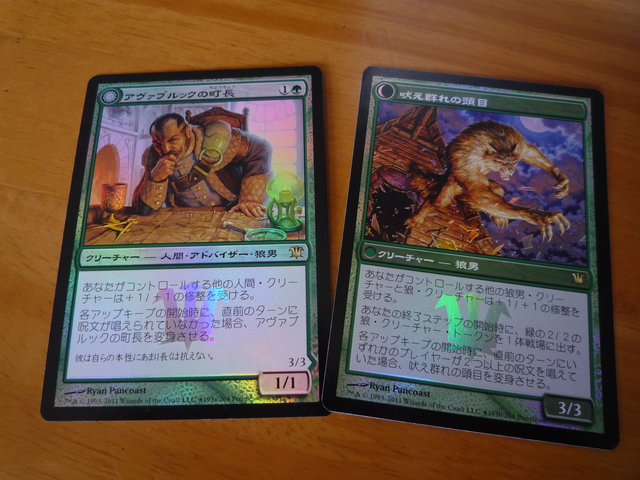
En esta colección hay cartas sin dorso, que tienen información por los dos lados. Se trata de criaturas que se transforman, acto que se representa dando la vuelta a la carta. Parece que la idea viene de Duel Masters, otro juego de cartas hecho por la misma empresa que el Magic pero que curiosamente solo se vende en Japón. La foto de aquí arriba (Alcalde de Avabruck / Alfa de la jauría aullante) es una carta especial que regalaban a todos los participantes, pero no se podía usar durante la competición. Como este Alcalde, la mayoría de las cartas de dos caras son hombres lobo. Y viendo las cartas que me habían salido en mis seis sobres de Innistrad (la primera competición era mazo sellado) decidí precisamente probar los hombres lobo, usando los colores verde y rojo. Me pareció curioso que, aunque tenía un par de cartas verdes que apoyan específicamente a los hombres lobo (Niebla lunar y Ascenso de la luna llena), la carta que más me ayudó fue una tierra: Municipio de Gavony.
このセットには両面カードというのがあって、ひっくり返すことでクリーチャーが変身することを表現する。このアイデアは、同じ会社が作っているデュエルマスターズというゲームから来たらしい。珍しいのは、デュエルマスターズは日本でしか販売されなくなったこと。この上の写真はアヴァブルックの町長/吠え群れの頭目、参加者がみんなもらった特別なカード(イベント中は使っていけなかったけど)。両面カードはほとんど「町長」みたいに狼男だ。僕の6パックの中身を見て(シールドというリミテッドの種類でした)赤緑の狼男デッキにしようと思った。面白かったのは、昇る満月や月霧みたいな狼男を補助するスペルを何枚か持っていたのに、結局一番役に立ったのは土地のガヴォニーの居住区だった。
In this set there are double-faced cards, which have no regular card back. They are creatures which can transform, an ability expressed in the game by flipping the card. It looks like the idea comes from Duel Masters, another game from the same company making Magic, only it’s currently only for sale in Japan. The picture above (Mayor of Avabruck / Howlpack Alpha) is a special card everyone attending the event got, only you didn’t get to use in in your deck for the competition. Like the Mayor, most double-faced cards are werewolves. And seeing the cards I got from my six Innistrad boosters, I decided to go with a green and red werewolf deck. I found it curious that, while I had some werewolf supporting cards like Moonmist and Full Moon’s Rise, the card that helped me most with them was a land: Gavony Township.

Después de perder dos de las rondas del sellado (aunque alguna gané), decidí abandonar esa competición y participar en un draft, otro formato limitado en el que solo se usan tres sobres de cartas, pero estas se reparten entre ocho jugadores consiguiendo todos un conjunto de cartas bastante coherente. Mi baraja resultó ser de vampiros, la tribu más agresiva de las presentes en Innistrad.
シールドの中で2回戦負けたら(勝ったときもあったけど!)その大会を諦めてドラフトをやってみようと思った。ドラフトとはもう一つのリミテッドで、3パックずつだけ配られてその中身のカードを8人の参加者が順番に選んでいくフォーマット。一人ずつかなり集中したカードを集めることになる。僕のデッキは吸血鬼、イニストラードの中で一番速攻できる種族。
After losing two rounds of sealed (I did win some) I decided to drop from that competition and join a draft, another format where you start with only 3 booster packs but you pick a card and pass to other players so you end up with a small but focused pool of cards. My deck turned out to be vampires, the most aggressive tribe on Innistrad.

Al ser un mazo tan agresivo resultó muy sinergético apoyarlo con muchas cartas para matar criaturas, y las estrellas de la baraja fueron dos Lanzador de furia, que hacían que cualquier combate fuese perjudicial para mi contrincante. Perdí en la semifinal por muy poco, pero ¡lo pasé muy bien en este mi primer draft!
速攻系のデッキだったから、相手のクリーチャーを殺せるカード一杯入れた。このデッキの切り札は2枚の憤怒を投げる者だった。こいつらのおかげで、どんな攻撃が起こっても僕の有利になった。準決勝でギリギリ負けたけど、初めてのドラフトは結構楽しかった!
Being it such an aggro deck it felt very synergetic to support it with lots of cards to kill other creatures, and the stars of the deck were two Rage Throwers who made any combat a lose-lose scenario for my opponent. I lost quite closely the round before the finals, but I had a great time at my first draft!
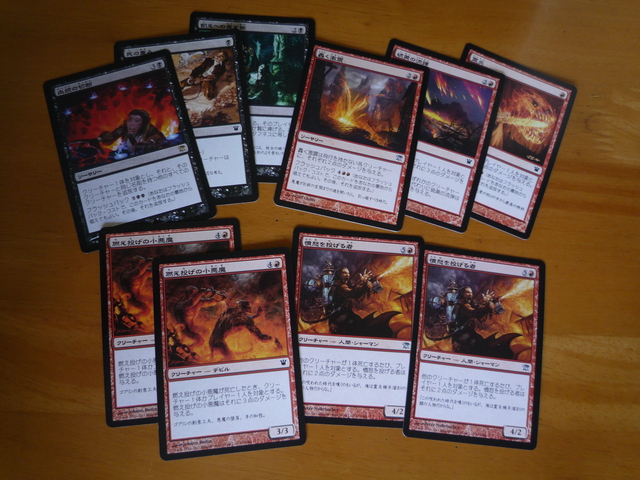
Y como os decía al principio, no tengo baraja. Así que el plan es vender las cartas que puedan tener algún valor. Aquí abajo os pongo una lista de cartas que tengo disponibles, algunas de Innistrad y otras de otros años.
上記でも書いてる通り、デッキを持たない人です。だから値段が付くカードを売りたい。下記は売りたいカードのリスト。イニストラードもちょっと前のも入ってる。
And like I wrote at the beginning, I don’t play constructed so I plan to sell all the valuable cards I have. Some are from Innistrad, some are older.
Innistrad
- 2 * アヴァブルックの町長/吠え群れの頭目 (フォイル プロモ)
2 * Mayor of Avabruck / Howlpack Alpha (foil promo)
2 * Alcalde de Avabruck / Alfa de la jauría aullante (promo foil)
- 森林の墓地
Woodland Cemetery
Cementerio boscoso
- ガヴォニーの居住区
Gavony Township
Municipio de Gavony
- ステンシアの血の間
Stensia Bloodhall
Salón sangriento de Stensia
- ケッシグの檻破り
Kessig Cagebreakers
Rompeceldas de Kessig
- 夜明けのレインジャー/黄昏の捕食者
Daybreak Ranger / Nightfall Predator
Guardabosque del amanecer / Depredadora del anochecer
- 迫り来る復興
Creeping Renaissance
Renacimiento reptante
- 血の贈与の悪魔
Bloodgift Demon
Demonio regalo de sangre
- 息せぬ群れ
Unbreathing Horde
Horda sin aliento
- 血統の切断
Sever the Bloodline
Cortar la línea de sangre
- ルーン唱えの長槍
Runechanter’s Pike
Lanza del cantarunas
Zendikar
- 水蓮のコブラ
Lotus Cobra
Cobra del loto
- 燃え立つチャンドラ
Chandra Ablaze
Chandra en llamas
Magic 2012
- 順応する自動機械
Adaptive Automaton
Autómata adaptativo
- 墓地を刈り取るもの
Cemetery Reaper
Segador del cementerio
- ウスーンのスフィンクス
Esfinge de Uthuun
Sphinx of Uthuun
Magic 2011
- 太陽のタイタン (フォイル プロモ)
Sun Titan (foil promo)
Titán solar (promo foil)
Magic 2010
- 吸血鬼の夜侯 (フォイル プロモ)
Vampire Nocturnus (foil promo)
Nócturnus vampiro (promo foil)
- ダークスティールの巨像
Darksteel Colossus
Coloso de acero oscuro
- 双つ術
Twincast
Jugada gemela
- ボール・ライトニング
Ball Lightning
Bola de rayos
- 惑乱の死霊
Hypnotic Specter
Espectro hipnótico
10th Edition
- Reya Dawnbringer (English foil promo)
黎明をもたらす者レイヤ (英語版 フォイル プロモ)
Reya Portaalba (promo foil en inglés)
Todas las cartas están en japonés y en perfecto estado si no se especifica lo contrario en la lista. Se vende barato, poneos en contacto conmigo por Twitter. Me gustaría dejar los comentarios libres para hablar de Innistrad, que me ha gustado mucho para jugar en limitado y me gustaría hacer otro draft.
一覧に書いている例外以外、カードは全て日本語版で使用感が全くありません。安く売りますよ!ツイッターでご連絡下さい。コメントではイニストラードの話がしたいと思います。イニストラードのリミテッドは面白いのでまたドラフトしたい。
All cards are in Japanese and mint / near mint unless noted. I’m selling them cheap! Please contact me on Twitter. I’d like to save the comments to talk about Innistrad. Innistrad was a lot of fun in limited and I’d love to draft it again.